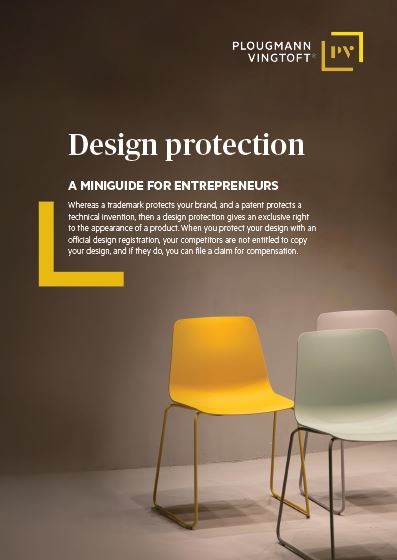
Whereas a trademark protects your brand, and a patent protects a technical invention, then a design protection gives an exclusive right to the appearance of a product. When you protect your design with an official design registration, your competitors are not entitled to copy your design, and if they do, you can file a claim for compensation.
Download a PDF file with The entrepreneur’s miniguide to design protection, or continue reading below.
What can I register as a design?
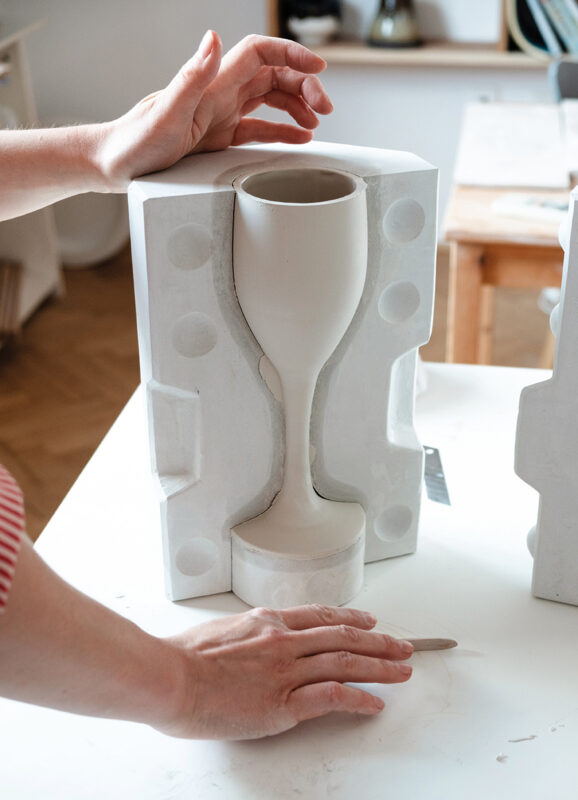 A design covers the appearance of the whole or a part of a product. There are no specific requirements with respect to aesthetics or quality, but it must be an industrial or handicraft item. A design can, however, not be protected, if its appearance is exclusively due to its technical function.
Examples of a design can be the appearance of the whole or a part of the product, product packaging, a set of products, graphical symbols such as logos and app icons, fonts, graphical user interfaces, ornamentations or patterns, web design, posters, maps or a specific interior decoration of a shop or something similar.
You can find examples of designs at EUIPO (European Union Intellectual Property Office).
What will I achieve if I register my design?
You will have a stronger position towards counterfeiters
A registered design provides a broader protection compared to a design which is not registered. A registered design will not only provide protection against subsequent designs from other companies, who are deliberately copying your design, it will also protect against a similar design irrespective of the intention of the counterfeiters.
If you have a design registration, you can also partly prevent people from deliberately or undeliberately copying your design and partly also prevent that your competitors register a similar design and obtain an exclusive right to this design. Furthermore, the design law contains a rule which applies a reversal of the burden of proof. This means that if you have a registered design, it is the ’infringer’, who must prove that your design was not new, and this can often be a difficult process.
You make your design publicly known
If you have a design registration, it is easy to prove that a specific design belongs to you. A design registration is made publicly available in such a way that it is reasonable to expect that any interested party would have obtained knowledge of your registered design.
Furthermore, a design registration has an application date which shows that as of that date, you have obtained an exclusive right to the design, if any other party should question who registered the design first. This means that if you have a design registration, you can always show what your design looks like, and when you obtained your right
You strengthen your business and your growth potential
A design registration is proof that you have created something unique. This strengthens your commercial position and provides a much better basis for making agreements, for instance, about licensing or a possible sale of the design right.
Furthermore, if you want to attract investors to your business, they highly value a design registration. They will not have to worry whether you are actually entitled to use your design in the way you do (and neither will you).
Two requirements for design protection
Irrespective of what you wish to protect, there are two overall requirements that you have to take into account, if your application for a design registration should be taken into consideration.
1) Novelty
Your design must be new. This means that no previously published identical designs must exist. However, in Denmark and the EU, the authorities will accept that you register a design,
which you have previously made publicly available. In order to be able to register a design in spite of the ”novelty requirement”, you must register the design within 12 months from the date, on which you published the product/design the first time.
2) Your design must possess individual character
Your design must differ substantially from existing products. It is therefore a good idea to search in different databases to find out, how your design differs from what has already been registered or introduced to the market without necessarily being registered. In this case, a few searches on Google® can often be a good indication.
The requirement concerning individual character and the extent to which the product must differ from already existing products depends on the type of product. If we are dealing with, for instance, a chair, which can be designed in many different ways, this means that minor differences are not enough to give the design an individual character. On the other hand, if there are many regulatory and technical requirements concerning the appearance of a specific type of product, which means that the design must have a distinct appearance, there are probably not many different ways in which the product can be designed. In this case, even minor differences would be enough to give the design an individual character.
Where should I register my design?
You can register a national design, an international design or an EU design. For some companies it is only relevant to register their design in specific countries, while for other companies it is more relevant to register their design in those countries, where the products are manufactured or sold.
If your company is based in Denmark, we recommend that you start with the registration of an EU design. An EU design is slightly more expensive, but is gives a larger geographical protection.
What does it cost, how long will it take, and how long is the duration?
The costs of a design registration depend on the number of countries where the design should be protected, how many variations there are, and which ones should be protected.
Normally, it only takes 10 working days from you file a design application, until you will receive a grant of the design registration in the EU. The design right will therefore be granted quickly.
A design protection is valid for five years from the filing date. If you wish to extend the protection of your design, it can be renewed for 5-year periods (up to a maximum of 25 years, 5 x 5 years). There is no duty to make use of a registered design, as is the case with trademarks.
Do you have more questions or do you need help?
If you have reached this part, it might be because you think that a design protection is the right solution for you and your company. In that case, find our design experts on this page and contact them directly – or send an inquiry using the form below.